

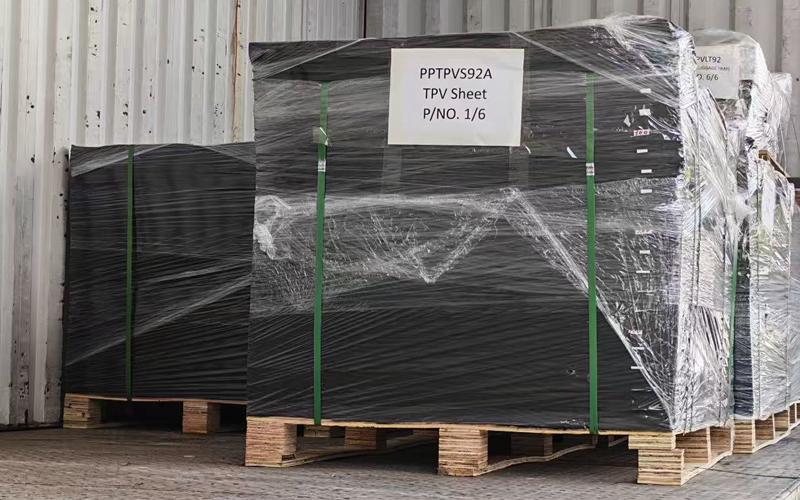
Two floor mat makers recently bought sheet from us. One is in Malaysia and took TPV. The other is in the Philippines and took TPE. Both make car floor mats, both run their own forming equipment and tools, and both bought flat sheet rather than finished parts.
That is a common situation, and the material question that comes with it is rarely settled by a datasheet alone. TPV and TPE are often quoted side by side, sometimes as if they were the same thing, and the price gap between them can be tempting to either ignore or overweight. This article sets out how the two differ in a floor mat application, which questions to settle before you order, and what to put in an inquiry so the first sample is usable.
Quick Answer: TPV or TPE for Car Floor Mats?
Neither material is better in every case. In general, TPV is the safer choice when the mat will see high cabin or trunk temperatures, heavy point loads, or years of being stepped on and flexed, because a dynamically vulcanized rubber phase usually gives better elastic recovery. TPE is often the better choice when the buyer wants a softer hand feel, a wider range of colors and grains, and a lower material cost per square meter, and the mat will not be asked to survive extreme heat.
Those are tendencies, not guarantees. "TPE" covers a wide family of compounds, and two TPE sheets from different suppliers can behave very differently. The grade, the hardness, and the test data for that specific grade matter more than the three-letter label.
What We Shipped: Two Orders, Same Application
The Malaysia order was TPV sheet. The Philippines order was TPE sheet. In both cases the end product is a car floor mat, and in both cases the customer already owns forming equipment and molds. They did not ask us to form the parts. They asked for sheet they could load into their own line.
That changes what a good sheet supplier has to deliver. A customer forming their own mats cares about how the sheet behaves under their heaters, whether the thickness is consistent from the edge of the roll to the middle, whether the grain survives the draw, and whether the next shipment matches the last one. Those points, rather than headline properties, decide whether a trial run turns into a repeat order.
We are not going to attribute the choice of material on either order to a single reason. Each customer has its own molds, vehicle models, climate, and price target. What we can say is how the two materials generally compare, and that is what the rest of this article covers.
What "TPE" and "TPV" Mean When You Buy Floor Mat Sheet
TPE stands for thermoplastic elastomer. It is a family of materials that combine rubber-like flexibility with the processing behavior of plastic: they soften when heated, can be extruded into sheet, and can be thermoformed. In the floor mat trade, "TPE" most often refers to styrenic-based or olefin-based compounds that have been formulated for flexibility, grain retention, and color.
TPV, thermoplastic vulcanizate, is technically one type of TPE. The difference is in how it is made. During compounding, a rubber phase (commonly EPDM) is crosslinked while it is being mixed into a polypropylene matrix. The result is a material with small cured rubber particles dispersed in a thermoplastic. That structure is the reason TPV is usually described as having better elastic recovery, better compression set, and better heat and oil resistance than non-vulcanized TPEs of similar hardness.
This is where buyers get confused. A supplier who quotes "TPE" may mean a styrenic compound, an olefin blend, or a TPV, depending on how loosely the word is used. If you are comparing quotes, ask each supplier which base polymer system the sheet uses, what hardness it is, and which test report covers that grade. Two sheets sold under the same name can sit at very different points on cost and durability.
TPV vs TPE Sheet: Side-by-Side Comparison
The table below describes typical tendencies for floor mat sheet. Individual grades vary, so treat it as a starting point for questions, not as a specification.
| Factor | TPV sheet | TPE sheet |
|---|---|---|
| Structure | Crosslinked rubber phase in a polypropylene matrix | Depends on grade; often styrenic- or olefin-based, not vulcanized |
| Elastic recovery | Usually stronger after repeated load and flexing | Good, but may show more permanent set under long-term load |
| Heat behavior | Generally better in hot cabins and trunks | Acceptable for many climates; check the grade if the vehicle sits in direct sun |
| Hand feel | Firmer, more rubber-like | Often softer; wide range possible |
| Surface and grain | Takes grain well; finish tends to look matte | Takes grain and color variety well |
| Forming behavior | Needs controlled heating; sheet sags as it softens | Similar, but the window varies more between grades |
| Scrap handling | Trim can often be reground; confirm for your grade | Same; confirm for your grade |
| Typical cost position | Often higher | Often lower, depending on grade |
| Typical use in cars | Floor mats, trunk mats, liners that must keep shape | Floor mats, trunk mats, liners where feel and price lead |
When TPV Is the Better Fit
TPV earns its price when the mat has to come back to shape. A driver's footwell takes the heaviest wear in the car: heel pressure on one spot, repeated pedal movement, wet shoes, sand, and a cabin that can reach high temperatures when parked in sun. A mat that flattens, curls at the edges, or loses its raised ribs after a season generates complaints, and complaints cost more than the material saving.
Trunk and cargo mats raise a similar issue. Loads sit on them, tools slide across them, and they are often folded or pulled out for cleaning. If the target market is hot, or the product is positioned as premium, TPV is a reasonable default. Our articles on cargo area liner material and truck bed liner material cover how load and temperature shape that choice in more detail.
TPV also suits buyers who want a single material they can use across several mat types without constant reformulation, because its performance tends to hold across a narrower band of conditions. You can see our current range on the TPV sheet page.
When TPE Is the Better Fit
TPE tends to win where the mat is sold on feel, color, and price. A softer sheet can give a more cushioned underfoot sensation and a less industrial look, and the range of colors and grains available in TPE compounds is generally wide. For aftermarket mats that compete on retail price in a market with moderate temperatures, that matters.
TPE is also worth a hard look when the buyer's volume is high and margins are tight. A well-formulated TPE grade will often perform well in ordinary passenger car use. The risk is less in the material class than in picking a grade that was formulated for something else, such as footwear or consumer goods, and expecting it to behave like an automotive sheet. If you go with TPE, ask for the data on the exact grade, including hardness, aging behavior, and any odor or VOC requirement your customers impose. See the TPE sheet page for what we supply.
How Your Forming Line Changes the Choice
Both TPV and TPE sheets can be vacuum formed, but neither behaves like a rigid sheet such as ABS or HDPE. They are elastomeric. They stretch, they sag under their own weight as they heat, and they spring back more after forming. Heater settings from a rigid-sheet line will not transfer directly.
If you already own equipment and molds, as both of our customers do, a few practical points apply.
Heating window. Ask the supplier for the recommended sheet surface temperature range and the heating time for your thickness. Overheating produces thinning at corners and surface marks; underheating gives poor definition of ribs and pockets. The right window differs between grades, so confirm it on a trial rather than assuming.
Draw depth. Deep pockets and raised edges, which are common in modern floor mat designs, put more demand on sheet elongation and thickness uniformity. A sheet that forms cleanly on a shallow flat mat may thin out on a deep-dish design.
Grain retention. Embossed grain can flatten at the stretch points. If the grain is part of the product's look, check a formed sample, not the flat sheet.
Shrinkage and trimming. Formed parts can move slightly as they cool. If your cutting fixtures are tight, confirm dimensional stability on a sample that has been through your full process.
Moisture and storage. Ask whether the grade needs any conditioning before forming, and how it should be stored. Do not assume the answer is the same for TPV and TPE.
If you do not have a forming line and want to buy finished parts, our vacuum forming service is a separate route, using your tooling.
Sheet Specs to Confirm Before You Order
The most common reasons a first order goes wrong are not exotic. They are missing details in the inquiry. Before you request a quotation, settle the following.
- Material and base system. TPV or TPE, and for TPE, the polymer family. Ask for the grade name.
- Hardness. State the Shore scale (A or D) and a target value with tolerance. Mixing up Shore A and Shore D is a common error.
- Thickness and tolerance. Give the nominal thickness and the tolerance you can accept across the width and along the length. Thickness consistency drives forming consistency.
- Width and format. Roll or cut sheet, and the width your machine accepts. Check maximum widths against the thickness, since supplier limits can vary by thickness.
- Color. Black is common, but give a color reference or a sample for anything else, and ask how color consistency between batches is controlled.
- Surface and grain. Specify the grain pattern, or send a sample. Confirm whether the grain is on one side or both, and whether it must survive the deepest draw.
- Performance requirements. Heat aging, UV exposure, low-temperature flexibility, odor and VOC limits, and any OEM or market regulation. Say which ones apply.
- Volume and schedule. Trial quantity, expected annual volume, and delivery window.
- Packing and destination. Port, container type, and any labeling requirement.
Our current catalogue lists ranges for hardness, thickness, width, color, and grain, and we will confirm the exact available ranges for your project when you send the inquiry. A short specification from you saves one or two rounds of back-and-forth.
Surface and Grain: A Detail That Decides Appearance
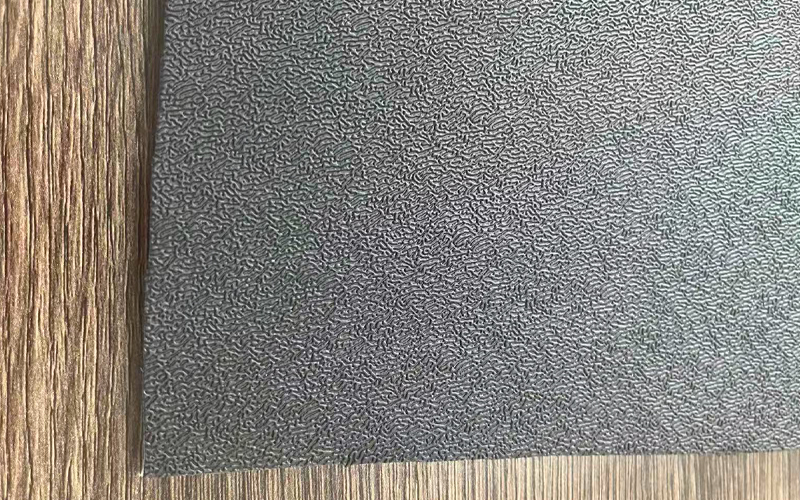
Floor mat buyers often look at grain before they look at anything else. A fine, even grain hides scuffs and gives the mat a finished look. A coarse grain can read as cheap if it is uneven, or as rugged if it is deliberate. The pattern is usually embossed on the sheet during production, and it then has to survive the forming draw.
Send a reference sample if you have one. If you are developing a new mat, ask for several grain options on a small trial run and form them on your own tool before committing to volume. The grain that looks best on flat sheet is not always the one that looks best on a deep-drawn mat.
Packing and Shipping Sheet for Export
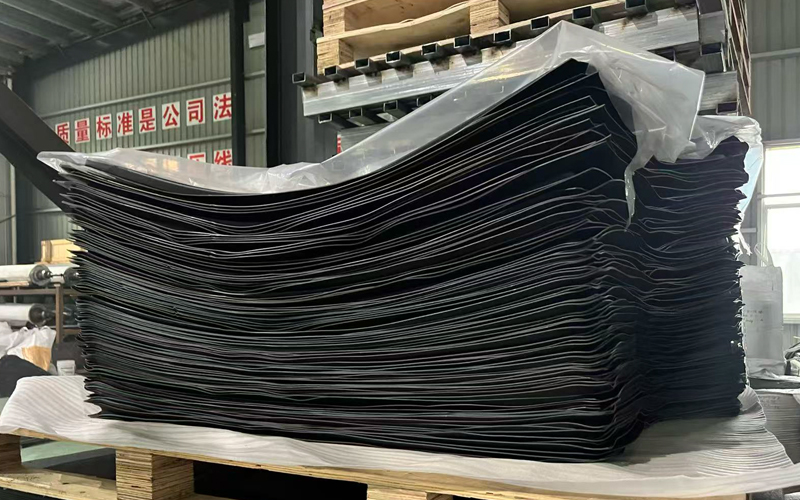
Sheet that arrives damaged or mixed up is worse than sheet that arrives late. For both orders described above, the sheet was stacked on wooden pallets, wrapped in stretch film, and labeled with the material and product information before loading. Pallets were loaded into the truck for transfer to port.
A few points are worth agreeing with your supplier in advance:
- Pallet size and weight. Check that pallets fit your forklift and your unloading area, and that the stack height is safe.
- Wrap and edge protection. Stretch film keeps dust and handling marks off the surface. For sheets where surface appearance matters, ask about interleaving or edge protection.
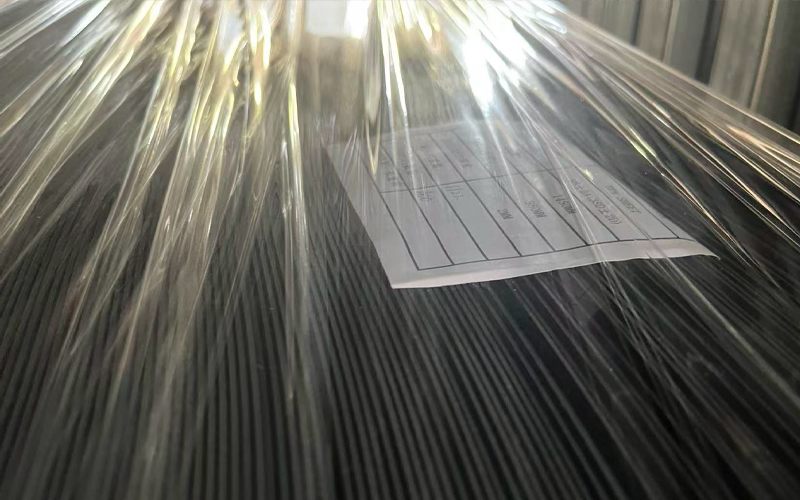
- Labeling. Each pallet should show the material, grade, thickness, dimensions, quantity, and batch. Clear labels let your warehouse check a shipment against the purchase order without opening it.
- Container loading. Ask how the pallets will be arranged in the container and whether they will be braced, especially for long sea routes.
- Batch records. If you form large quantities, keep batch numbers on file. If color or hardness drifts between shipments, the batch number helps trace it.
How to Start: Sample, Test, Trial Order
Most customers in this field follow the same path: confirm the parameters, receive a sample, test it on their own line, place a trial order, and then move to regular volume. That path works because it lets you find forming problems on a small quantity instead of a full container.
When you contact us, the most useful information to send is:
- The application (driver's mat, rear mat, trunk mat, or liner) and the vehicle models.
- Your forming method and sheet width limit.
- Target material (TPV, TPE, or "advise") and target hardness.
- Thickness, color, and grain.
- Trial quantity and expected annual volume.
- Destination country and port.
If you are not sure whether TPV or TPE suits your product, tell us the market, the vehicle type, and your price target, and we will suggest which to sample first. For a broader look at the sheet category, see What Are Thermoplastic Sheets? and our guide to commercial vehicle floor mat material.
FAQ
Is TPV better than TPE for car floor mats?
Not always. TPV usually has better elastic recovery and heat resistance, which helps in hot climates and heavy-use mats. TPE can offer a softer feel, more color and grain options, and a lower price. The better choice depends on your market, your price target, and the specific grade.
Is TPV a type of TPE?
Yes. TPV is a thermoplastic elastomer in which the rubber phase has been crosslinked during compounding. Many suppliers use "TPE" for non-vulcanized grades and "TPV" for vulcanized ones, but the usage is not consistent, so confirm the base system when you compare quotes.
Can I form TPV and TPE sheet on the same machine?
Usually yes, since both can be thermoformed. The heater settings, forming temperature, and cooling will differ by grade, so run a trial and record the settings for each material.
What thickness should I order for floor mats?
It depends on the mat design, the draw depth of your tool, and the feel you want. Give us the mat design and your forming method, and we will recommend a thickness to sample, then adjust from the trial result.
Can I get a sample before placing a bulk order?
Yes. Samples are the normal first step. Send your specification and we will advise what to sample and how to test it.
Do you form the mats as well?
For these two orders we supplied sheet, since the customers form the parts themselves. If you need finished parts from your own tooling, see our vacuum forming service.
Ready to compare TPV and TPE for your floor mat project? Send us your specification and we will reply with sample options.